
• facebook
  • x
  • instagram
  • youtube

New Heat Dissipation Device Design Achieves a 47% Weight Reduction in an NTN Planar Antenna

- Operation confirmed as a satellite communication user terminal, enabling installation on drones and vehicles -
June 17, 2026

National Institute of Information and Communications Technology
Sharp Corporation
Mitsubishi Chemical Corporation
TECHLAB Co., Ltd.

Highlights

  • A new heat dissipation device design achieved a 47% weight reduction in an NTN planar antenna.
  • A newly designed heat dissipation device made from a novel composite material combining carbon fiber prepreg and graphite sheet was integrated into the NTN planar antenna, and the antenna’s required electrical performance was confirmed.
  • Operation was also confirmed for a satellite communication user terminal consisting of the lightweight planar antenna and a modem, enabling installation on mobility platforms such as drones and vehicles.
  • This achievement enables installation of the terminal on a wide range of mobility platforms, including drones and vehicles, and marks a major step toward the realization of NTN.
The National Institute of Information and Communications Technology (NICT, President: OHNO Hideo, Ph.D.), Sharp Corporation (Sharp, CEO: KAWAMURA Tetsuji), Mitsubishi Chemical Corporation (Mitsubishi Chemical, President: CHIKUMOTO Manabu), and TECHLAB Co., Ltd. (TECHLAB, President and Representative Director: HATAKEYAMA Hiroshi) jointly reduced the total weight of a planar antenna for NTN (Non-Terrestrial Network) applications by 47% (from 5.5 kg to 2.9 kg) through a new heat dissipation device design.
This was achieved by integrating a CFRP heat dissipation device using a composite material combining carbon fiber prepreg and graphite sheet into the NTN planar antenna. The required electrical performance of the planar antenna was also confirmed. In addition, operation including the modem was confirmed as a satellite communication user terminal.
The achievement greatly expands the range of mobility platforms on which the terminal can be deployed, including drones and vehicles. It is expected to support the establishment of communication links in mountainous areas and disaster-affected regions, real-time transmission of location information from various types of mobility, and future applications such as autonomous driving, thereby representing a major step toward the realization of NTN.

Background

In NTN, satellite communications enable high-speed connectivity even in environments where terrestrial mobile communications are difficult, such as mountainous areas, offshore locations, remote islands, and disaster-affected regions. On the other hand, NTN planar antennas for satellite communication user terminals require tracking functionality for satellites and HAPS. This tracking function generates significant heat, making high thermal conductivity and effective heat dissipation essential. In addition, further miniaturization and weight reduction are essential in order to mount satellite communication user terminals on diverse mobility platforms. To address these challenges, the four parties have been jointly conducting R&D on materials with both high thermal conductivity and low weight, along with the design, molding, integration, and evaluation of heat dissipation devices.

Achievements

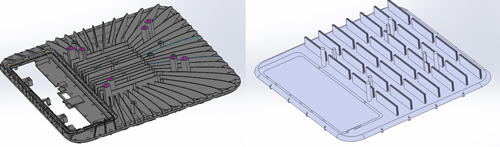
Figure 1. Structure of the heat dissipation devices made of different materials
Left: conventional aluminum heat dissipation device
Right: composite-material-based heat dissipation device
NICT, Sharp, Mitsubishi Chemical, and TECHLAB jointly achieved a 47% reduction in the weight of an NTN planar antenna through a new heat dissipation device design. In this achievement, NICT identified design guidelines for lightweight heat dissipation devices based on the weight and thermal conductivity challenges of conventional aluminum heat dissipation devices for planar antennas and conducted R&D on the composition of the novel composite material and the device structure adopted in this work (see Figure 1).
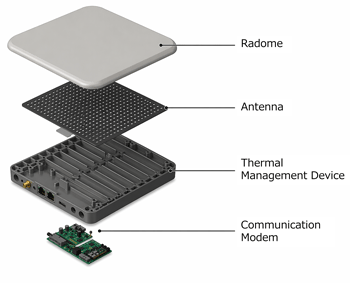
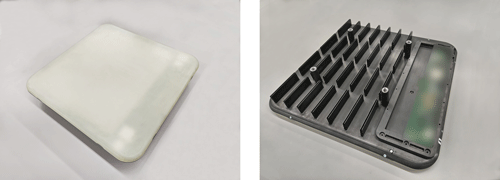
Mitsubishi Chemical developed the carbon fiber prepreg and graphite sheet materials used in the composite material, while TECHLAB established the design and molding technology for a heat dissipation device using the composite material. This enabled the fabrication of a CFRP heat dissipation device that takes advantage of the material’s low weight and high thermal conductivity, achieving a device weight of less than 1 kg. Sharp then integrated this CFRP heat dissipation device into the NTN planar antenna and achieved a 47% weight reduction (5.5 kg to 2.9 kg) (see Figure 2, Figure 3). Evaluation of antenna characteristics confirmed that differences in the radiation pattern were within the measurement error range of the terminal and that there was no difference in receive gain characteristics.
Furthermore, the newly developed NTN planar antenna was integrated with a modem and other components, and operation was confirmed as a satellite communication user terminal. This demonstrated that a much lighter satellite communication user terminal can be realized, falling within the payload capacity of widely used industrial drones, and can be directly mounted and operated on a wide range of mobility platforms, including drones and vehicles, thereby expanding the range of applicable mobility platforms.
Figure 2. Developed NTN planar antenna (approximately 45 cm square)
 Left: front view, Right: back view
Figure 3. Conceptual image of a satellite communication user terminal integrating a heat dissipation device,
a flat-panel antenna, and a communication modem

Future Prospects

Going forward, the partners will conduct more detailed evaluations of heat dissipation performance and mountability, while studying optimal heat dissipation device designs for different terminal configurations and applications. With a view to practical implementation of ultra-compact and lightweight satellite communication user terminals for mobility applications, the partners will continue prototyping and demonstration efforts and aim to contribute to the future realization of NTN.

Roles of each organization

  • NICT: Overall design and simulation of antennas for ultra-miniaturization and lightweight structures, including heat dissipation designs
  • Sharp: Development of LEO satellite communication user terminals utilizing miniaturization and communication technologies cultivated in smartphone design
  • Mitsubishi Chemical: Development of new lightweight, high thermal conductivity composite materials for heat dissipation plates
  • TECHLAB: Molding and processing technologies for the new composite materials

Related Previous Press Releases

Glossary

NTN(Non-Terrestrial Network) A non-terrestrial communications network that uses satellites, high-altitude platforms, and other airborne or spaceborne systems, in contrast to terrestrial networks. Back to contents

CFRP(Carbon Fiber Reinforced Plastic) Carbon-fiber-reinforced plastic, a composite material that is lightweight and offers high rigidity and strength. Back to contents

Carbon Fiber Prepreg A sheet-form material in which carbon fibers are pre-impregnated with resin. It is used to manufacture lightweight, high-strength composite materials. Back to contents

Graphite Sheet A thin sheet made of graphite. It offers high thermal conductivity, heat resistance, and flexibility, and is used for heat dissipation and sealing in electronic and industrial applications. Back to contents

HAPS(High Altitude Platform Station) An aerial base-station-type communications system that uses unmanned aircraft or airships operating in the stratosphere. Back to contents

Technical Contact

OKURA Takuya
Space Communication Systems Laboratory
Wireless Networks Research Center
Network Research Institute
National Institute of Information and
Communications Technology

Business Promotion Division
Next generation communications business unit
Mobile Communication BU
Sharp Corporation

Media Relations Group
Corporate Communications Department
Mitsubishi Chemical Corporation

Tel: +81-3-6748-7140

OZAKI Tsuyoshi
Head Office & Development Center
TechLab Co., Ltd.

Media Contact

Press Office
Public Relations Department
National Institute of Information and
Communications Technology

Media Relations Group
Corporate Communications Department
Mitsubishi Chemical Corporation

Tel: +81-3-6748-7140

SHIMA Tsuyoshi
Head Office & Development Center
TechLab Co., Ltd.