




World's First Successful 2 Tbit/s Free-Space Optical Communication Using Small Optical Terminals Mountable on Satellites and HAPS
December 16, 2025
Highlights
-
World's first achievement of 2 Tbit/s free-space optical communication using small optical terminals that can be mounted on satellites and High Altitude Platform Stations (HAPS)
-
Maintained stable optical communication between two types of small terminals separated by 7.4 km in an urban environment with atmospheric turbulence
-
Marked a major step forward in the practical application of Non-Terrestrial Networks (NTN) for Beyond 5G/6G
The National Institute of Information and Communications Technology (NICT, President: TOKUDA Hideyuki, Ph.D.) has successfully demonstrated 2 Tbit/s Free-Space Optical (FSO) communication using small optical communication terminals that can be mounted on satellites and HAPS, marking a world first for this technology.
This experiment involved horizontal free-space optical communication between two types of small portable optical terminals developed by NICT: a high-performance FX (Full Transceiver) installed at NICT Headquarters (Koganei, Tokyo) and a simplified ST (Simple Transponder) installed at an experimental site 7.4 km away (Chofu, Tokyo). Despite the difficult conditions of an urban environment with atmospheric turbulence that disrupts laser beams, the system maintained a stable total communication speed of 2 Tbit/s via Wavelength Division Multiplexing (WDM) transmission of 5 channels (400 Gbit/s each). This is the first time in the world that terabit-class communication has been realized using terminals miniaturized enough to be mounted on satellites or HAPS.
Moving forward, NICT plans to further miniaturize the terminals for implementation onboard a 6U CubeSat. NICT aims to conduct free-space optical communication demonstrations at speeds of up to 10 Gbit/s between a Low Earth Orbit (LEO) satellite (altitude approx. 600 km) and the ground in 2026, and between a satellite and HAPS in 2027. Through these experiments, NICT will demonstrate compact, ultra-high-speed data communication capabilities and pave the way for the realization of Beyond 5G/6G Non-Terrestrial Networks (NTN).
Background
Free-Space Optical (FSO) communication, which transmits laser light through space without optical fibers, is attracting attention as a fundamental technology supporting high-capacity communication between the ground, the sky, and space. While demonstrations of FSO exceeding Tbit/s speeds have been advancing, primarily in Europe, previous experiments utilized large, stationary equipment in laboratory-style configurations (see Appendix). These configurations face challenges in meeting size and weight constraints for mounting on mobile platforms such as satellites or HAPS and in maintaining stable communication in fluctuating environments. Furthermore, in Asia, there have been no reports of FSO demonstrations exceeding the terabit level, with speeds reported to reach at most around 100 Gbit/s (see Appendix).
Achievements
The terminals used in this demonstration were designed for integration into microsatellites, including CubeSats. They meet size and weight constraints, distinguishing them from conventional laboratory-style configurations that use large stationary equipment. To achieve miniaturization, NICT strictly adhered to a design policy that fits within the severe Size, Weight, and Power (SWaP) constraints of CubeSats. NICT implemented three approaches:
1. Development of custom-designed components (e.g., a 9 cm-class telescope meeting optical quality requirements for the space environment).
2. Redesign and modification of commercial components (e.g., a miniaturized fine steering mirror improved to handle high-power laser beams in a vacuum).
3. Active utilization of existing components (e.g., repurposing high-speed optical transceivers for data centers and incorporating them into modems).
By implementing these approaches, NICT was able to reduce the size, weight, and power consumption of the entire device while maintaining all the required functions and minimizing the burden on the platform.
Additionally, to handle dynamic environments assumed for mobile operation, NICT implemented high-precision alignment using coarse acquisition and fine tracking. NICT also implemented its proprietary Beam Divergence Control (BDC) technology, which dynamically adjusts the laser beam divergence according to link conditions. This design, enabling stable communication in mobile environments, is a key feature of these terminals and distinguishes them from conventional fixed-station experimental equipment.
Furthermore, the developed terminals allow for flexible selection of configuration (ST or FX) and modem type (10 Gbit/s type or 100 Gbit/s type) based on communication requirements, as well as adaptive operation according to link conditions via internal adjustment functions.
This demonstration was achieved by overcoming technical challenges for mounting on mobile platforms—such as miniaturization of optical systems and high-precision, flexible beam control—through the development of novel functions such as variable transmission speeds and variable beam widths tailored to the communication environment. It represents a significant step toward the practical realization of Beyond 5G/6G Non-Terrestrial Networks.
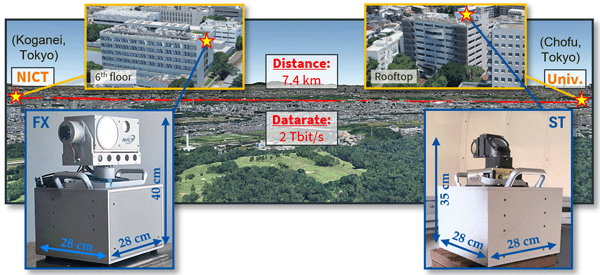
Figure 1: NICT's 7.4 km, 2 Tbit/s horizontal propagation experiment (April 2025). The ST terminal was used as the transmitter and the FX terminal as the receiver. The terminals exchanged pseudo-random binary sequences (PRBS) to evaluate line quality. A transmission speed of 2 Tbit/s is equivalent to sending approximately 10 full-size 4K UHD movies per second.
Future Prospects
As the next step, NICT is preparing for a new experimental campaign in 2026 in which the small optical communication terminals (ST and FX) will be mounted on mobile platforms to simulate realistic links involving satellites and HAPS. In these experiments, NICT plans to verify the performance of the coarse acquisition and tracking system and the fine tracking system while both communicating terminals are in motion, demonstrating the feasibility of a multi-terabit optical backbone under dynamic conditions for Non-Terrestrial 6G Networks.
Simultaneously, NICT is working on a CubeSat mission scheduled for launch in 2026, aiming to verify a gimbal-less FX terminal (called CubeSOTA) combined with a 10 Gbit/s modem in orbit. While the CubeSat form factor cannot yet accommodate the power and volume of a 2 Tbit/s modem, NICT is proceeding with the miniaturization and environmental hardening of multi-Tbit/s modems for future on-orbit demonstrations. NICT aims to realize optical communication links in the multi-Tbit/s range between satellites, HAPS, and ground stations within the next 10 years.
Appendix
1 Small Optical Communication Terminals
The small optical communication terminals developed by NICT consist of two types: the high-performance FX (Full Transceiver) and the simplified ST (Simple Transponder) (see Figure 2). In 2024, NICT completed the development of the first practical prototypes used in this experiment. These terminals are designed to flexibly adapt to various platforms and scenarios through their component configuration and internal adaptive operation, allowing for the selection of an appropriate basic configuration depending on the application. The ST type is intended for small platforms or simple operations, while the FX type is selected when high capacity and high performance are required. Furthermore, depending on communication requirements, a 10G modem type (10 Gbit/s or less) or a 100G modem type (100 Gbit/s or more, capable of handling the Tbit/s range by using multiple channels via wavelength division multiplexing) can be selected to meet a wide variety of requirements. Once the basic configuration is determined, the terminal automatically adapts its performance according to fluctuating link conditions via internal adjustment functions.
To fit the terminals within the strict size, weight, and power consumption (SWaP) constraints of CubeSats, and to handle the dynamic environments assumed for mobile operation, the following three approaches were implemented:
· Development of Newly Designed Components: Examples include a 9 cm telescope (FX terminal) that achieves excellent optical performance in a compact form, and a novel configuration integrating a 3 cm telescope with a gimbal (ST terminal). Additionally, to handle dynamic environments assumed for mobile operation, NICT uniquely developed Beam Divergence Control (BDC) technology capable of dynamically adjusting the laser beam divergence according to link conditions. Currently, this technology is implemented only on NICT’s terminals. One of its features is that it facilitates laser pointing, addressing the challenge of narrowed beam widths typical in short-range communication, thereby ensuring a stable connection.
· Redesign and Modification of Commercial Components: Commercial MEMS mirrors were improved to withstand high optical power even in a vacuum while leveraging their characteristics that allow for miniaturization. Conventionally, it was necessary to use larger mirrors or lower the optical power, but these challenges have been overcome by NICT’s novel design. This is implemented as part of the high-precision alignment function using coarse tracking (gimbal) and fine tracking (MEMS mirror) to handle dynamic environments assumed for mobile operation. In addition, the optical amplifiers have been miniaturized and adapted for use in space environments based on commercial products.
· Active Utilization of Commercial Components: Commercial components are also actively utilized after verifying that they operate reliably in the space environment. A representative example is the high-speed transceivers adopted to miniaturize the modem.
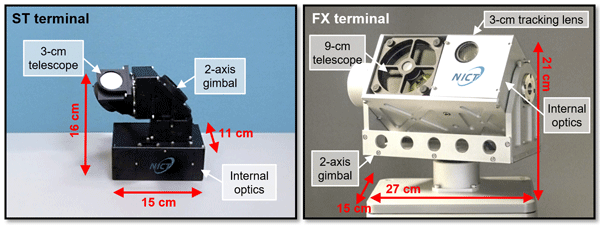
Figure 2: ST and FX free-space optical communication terminals developed by NICT
2 Tbit/s Modem
The 2 Tbit/s modem (see Figure 3) was designed with a compact form factor (a single 20×20 cm board) so that it can be used in field experiments in combination with ST and FX terminals. This modem multiplexes 5 channels of 400 Gbit/s to achieve a maximum transmission rate of 2 Tbit/s on the same transmission path. Each channel is capable of operating at a maximum of 400 Gbit/s, but if the link conditions deteriorate, the data rate can be reduced to 100 Gbit/s. Optical signals for each channel are multiplexed into a single optical fiber by the modem and transmitted after high-power amplification. On the receiving side, the received weak optical signals are pre-amplified, and then the five channels are separated to remove noise and improve the signal-to-noise ratio.
To achieve miniaturization of the 2 Tbit/s modem, NICT applied methods demonstrated in the previous 10 Gbit/s modem. The conventional method of combining individual components increases the size of the modem, while integrating the entire modem using Photonic Integrated Circuits (PIC) requires significant investment and time. Therefore, NICT adopted a hybrid approach utilizing small, high-performance components used in terrestrial optical communication, effectively incorporating high-speed optical transceivers developed for data centers into this small free-space optical communication modem, thereby achieving both miniaturization and high performance.
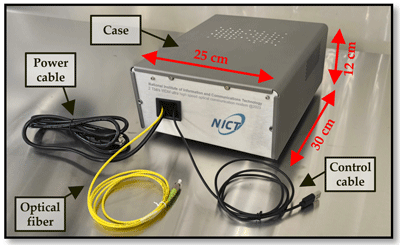
Figure 3: 2 Tbit/s compact modem prototype developed by NICT
3 Experiment Configuration
This experiment was conducted by installing the FX terminal at NICT and the ST terminal at an experimental site 7.4 km away, with different types of terminals at each end. To significantly increase the transmission speed compared with the demonstration experiment using a 10 Gbit/s modem conducted in 2024, the 2 Tbit/s modem was selected for this experiment. The primary function of the terminals in this experiment is to maintain high-precision alignment between the terminals. This is realized by a coarse acquisition and tracking system (2-axis gimbal) and a fine tracking system (MEMS mirror). Additionally, the terminals perform high-power amplification before transmission (compensation for channel loss) and low-noise amplification after reception (raising the received signal power level to an allowable range), filtering background noise by removing out-of-band components.
The external dimensions of the ST terminal and FX terminal used in the experiment are 35 × 28 × 28 cm and 40 × 28 × 28 cm, respectively, with masses of approximately 13 kg and 28 kg; they are designed to be compact enough to be mounted on HAPS or satellites. Generally, HAPS payloads are constrained to dimensions of approximately 30-50 cm, mass of 5-25 kg, and power consumption of around 50-200 W; the ST and FX terminals generally meet these constraints while being equipped with a 2-axis gimbal. Furthermore, additional miniaturization is underway for the development of terminals for satellites. The optical head itself has already been miniaturized (see Figure 2), and the heaviest subsystems common to both terminals—control electronics, optical amplifiers, and power management units (shown as the square box under the optical head in Figure 1)—have already been miniaturized for the satellite-mounted version (not yet integrated into the current ST/FX prototypes). As a result, the mass of the entire satellite terminal is approximately 4 kg (excluding the gimbal), with the goal of fitting it into half the space of a 6U CubeSat scheduled for launch in 2026. Through this initiative, the new ST/FX terminals are expected to achieve a reduction of over 50% in both occupied volume and mass.
4 Comparison with Overseas Cases
Horizontal free-space optical communication experiments at ground level are conducted under realistic atmospheric conditions prior to demonstration in space. In recent years, successful communication experiments exceeding 100 Gbit/s have been reported. In Asia, there were no reports of Tbit/s-class free-space optical communication experiments prior to NICT's experiment, although a Chinese research team achieved 120 Gbit/s over a distance of 1 km in Changchun in 2018, 100 Gbit/s over a distance of 2.1 km in Beijing in 2021, and single-channel communication of 112 Gbit/s over a distance of 104.8 km at Qinghai Lake in 2025.
In Europe, the German Aerospace Center (DLR) conducted an experiment of 13.16 Tbit/s total over 54 channels at 10.45 km in 2019. In 2023, ETH Zurich succeeded in 1 Tbit/s communication on a single channel over 53 km crossing the Swiss Alps. In addition, 4 Tbit/s in Aveiro, Portugal (2023), and 5.7 Tbit/s in Eindhoven, the Netherlands (2025), have been reported.
In all these Tbit/s-class horizontal links, the modem systems were configured by combining discrete components such as laser light sources, modulators, and receivers in a laboratory-style setup centered on rack/benchtop measuring instruments such as large arbitrary waveform generators and high-performance sampling oscilloscopes. Coherent signal processing and FEC decoding were often performed by analyzing acquired waveforms offline with external software, using numerous optical fiber patches and multiple racks of high-power equipment; thus, mounting on mobile platforms with size, weight, and power (SWaP) constraints is not realistic.
Furthermore, the free-space optical transmission sections were also configurations where commercial telescopes and optical components were assembled in a laboratory-style setup at fixed rooftop stations, and did not support environments where the platform moves dynamically. Therefore, these remained merely proofs of concept and were not systems suitable for the purpose of supporting Non-Terrestrial Networks (NTN) by mounting on mobile platforms like HAPS and satellites.
The 2 Tbit/s communication over 7.4 km achieved by NICT in this experiment is the first realization of long-distance and ultra-high-speed communication using small and lightweight terminals and modems, representing a major step forward toward practical application.
References
[1] Alberto Carrasco-Casado et al. “Miniaturized Multi-Platform Free-Space Laser-Communication Terminals for Beyond-5G Networks and Space Application”, MDPI Photonics, 11(6), 545 (2024) https://doi.org/10.3390/photonics11060545
[2] Xianglian Feng et al. “120 Gbit/s High-Speed WDM-QPSK Free-Space Optical Transmission through 1 km Atmospheric Channel”, Electronics Letters, 54 (18), 1082-1084 (2018) https://doi.org/10.1049/el.2018.5450
[3] Yueying Zhan et al. “Demonstration of 100 Gbit/s Real-Time Ultra-High-Definition Video Transmission over Free-Space Optical Communication Links”, Optical Fiber Communication Conference (OFC 2021), paper W7E.3 (2021) https://doi.org/10.1364/OFC.2021.W7E.3
[4] Zhaofeng Bai et al., “112 Gbit/s single-wavelength FSO communication with 104.8 km horizontal atmospheric link over Qinghai Lake”, Optics Express, 33, 9 (2025) https://doi.org/10.1364/OE.554608
[5] Annika Dochhan et al. “13.16 Tbit/s Free-Space Optical Transmission over 10.45 km for Geostationary Satellite Feeder-Links”, Proceedings of the IEEE ITG Symposium on Photonic Networks (2019) https://ieeexplore.ieee.org/document/8727109
[6] Yannik Horst et al. “Tbit/s Line-Rate Satellite Feeder Links Enabled by Coherent Modulation and Full-Adaptive Optics”, Nature - Light: Science & Applications, 12, 153 (2023) https://doi.org/10.1038/s41377-023-01201-7
[7] Marco A. Fernandes et al. “Achieving Multi-Terabit FSO Capacity with Coherent WDM Transmission over a 1.8 km Field Trial, ”European Conference on Optical Communication (ECOC 2023), paper We.D.1.1 (2023) https://doi.org/10.1049/icp.2023.2515
[8] Vincent van Vliet et al. “5.7 Tb/s Transmission over a 4.6 km Field-Deployed Free-Space Optical Link in Urban Environment”, arXiv preprint arXiv:2503.21058 (2025) https://doi.org/10.48550/arXiv.2503.21058
Glossary
Free-Space Optics (FSO)
A communication method that transmits laser light through space. It is applicable to high-speed communication on the ground, between the ground and space, and in outer space.
Wavelength Division Multiplexing (WDM)
A technology that uses multiple wavelengths of light simultaneously to transmit a large amount of data over a single optical path. Effective for expanding communication capacity.
High Altitude Platform Station (HAPS)
Platforms such as unmanned aircraft or balloons that stay in the stratosphere (approx. 20 km) for long periods. They are expected to be used for relaying between ground stations and satellites and for supplementing communication infrastructure during disasters.
CubeSat
A standard for small satellites. 1U (unit) is a cube with 10 cm sides; 6U is six times that size. Widely used by research institutions and universities due to low cost and rapid development/launch capabilities.
Non-Terrestrial Network (NTN)
A communication network that utilizes platforms other than terrestrial ones, such as satellites and HAPS.
Technical Contact
Space Communication Systems Laboratory
Wireless Networks Research Center
Network Research Institute
E-mail: contact-spacecomm ml.nict.go.jp
ml.nict.go.jpMedia Contact
Press Office
Public Relations Department
E-mail: publicitynict.go.jp
nict.go.jp