




National Institute of Information and Communications Technology Launches Its 6th Mid- to Long-Term Plan
The National Institute of Information and Communications Technology (NICT, President: OHNO Hideo, Ph.D.) has announced its 6th Mid- to Long-Term Plan, covering the five-year period from April 1, 2026, to March 31, 2031.
In recent years, social challenges such as rising energy consumption, intensifying natural disasters, increasing cyber risks, and heightening geopolitical tensions have become more pronounced. Simultaneously, the ICT environment is evolving at an unprecedented pace, driven by rapid advances in generative AI and broader progress in cutting-edge fields, including quantum technologies. Under these circumstances, achieving innovation while balancing economic growth and social sustainability requires not only accelerating digital transformation (DX) across society, including the effective use of AI, but also enhancing society’s capacity to anticipate and respond to constant changes. Furthermore, as dependence on overseas digital technologies increases, ensuring “technological autonomy and strategic indispensability” in critical digital infrastructure has become an urgent priority from a national security perspective.
In this context, ICT is becoming increasingly vital both as a foundational technology supporting national competitiveness and security and as a key driver of Japan’s growth strategy. Based on this recognition, NICT’s 6th Mid- to Long-Term Plan identifies the following four strategic fields: AI and Communication, Beyond 5G, Quantum ICT, and Cybersecurity. As a central hub connecting industry, academia, and government, NICT will contribute to advancing key national policies. It will strategically promote integrated initiatives that combine research and development (R&D) with practical deployment while fostering synergies across these fields. NICT also aims to serve as an “architect” by designing and integrating technologies and systems from a holistic optimization perspective.
In addition, as the foundation underpinning these strategic initiatives, NICT will steadily advance basic and foundational R&D across five priority areas that constitute its core technological strengths: Advanced Electromagnetic Technology, Innovative Networks, Cybersecurity, Universal Communication, and Frontier Science. By promoting seamless R&D from basic research to advanced development, NICT seeks to strengthen its capabilities and drive future innovation.
To maximize the impact of limited resources and accelerate both research outcomes and their timely deployment in society, NICT will strengthen its capabilities for social implementation and external collaboration. This includes strengthening its innovation hub capabilities to integrate initiatives across academia, industry, and government over the full path from fundamental research to societal deployment, while reinforcing its role as a platform that connects diverse stakeholders.
With the goals of “building disaster-resilient and robust social infrastructure,” “creating a safe and trustworthy information and communications environment,” and “enhancing efficiency while generating new value through digital transformation,” NICT will continue to work closely with all stakeholders and will devote its full efforts to advancing ICT that supports the society of the future.
Appendix 1
Overview of the 6th Mid- to Long-Term Plan
Ⅰ Measures to Maximize R&D Outcomes and Improve Operational Quality
1. Strategic Technology Fields
(1) AI and Communication
(2) Beyond 5G
(3) Quantum ICT
(4) Cybersecurity
2.Priority Areas for Basic and Foundational R&D
(1) Advanced Electromagnetic Technology includes remote sensing technologies, space environment technologies, and electromagnetic compatibility technologies essential for advanced data collection and high-precision observation using diverse sensors and electromagnetic waves across various frequency bands.
(2) Innovative Networks include network architecture technologies, photonic network technologies, and optical and radio convergence technologies essential for achieving high-speed and reliable transmission across terrestrial and space environments.
(3) Cybersecurity includes cyber threat intelligence platform technologies, human-centered cybersecurity technologies, AI-enabled cybersecurity technologies, and next-generation cryptography and privacy protection technologies essential for protecting social systems and citizens from cyber threats.
(4) Universal Communication includes integrated AI technologies that enhance creativity, diversity, and safety, as well as communication technologies capable of handling multimodal data (e.g., images and audio) and contextual information.
(5) Frontier Science includes advanced ICT foundation technologies, frontier ICT technologies, bio-inclusive ICT platform technologies, and brain-ICT interface technologies that support future innovative ICT concepts.
3.Foundational R&D Themes Supporting Innovation
(1) Resilient ICT Foundational Technologies
(2) Beyond 5G Architecture Technologies
(3) Terahertz-wave ICT Platform Technologies
(4) Global Quantum-secure Network Technologies
(5) Testbed Construction Technologies for the Beyond 5G Era
(6) Advanced ICT Device Development Platform Technologies
4.Social Implementation and External Collaboration Functions
(1) Strengthening NICT’s innovation hub functions to promote the social implementation of technologies originating in Japan
(2) Strengthening functions as a funding agency
(3) Enhancing frameworks for promoting the social implementation of R&D outcomes
(4) Promoting strategic standardization activities
(5) Promoting proactive and strategic international collaboration
(6) Advancing national resilience initiatives
(7) Strengthening ICT human resource development
(8) Providing research support and promoting industrial development
(9) Other operations
5.Operations Under Article 14, Paragraph 1, Items 3-5 of the NICT Act
(1) Establishment of frequency standards, transmission of standard radio waves, and dissemination of standard time
(2) Monitoring and forecasting of radio wave propagation, transmission of warnings regarding anomalies, and other related communication services
(3) Testing and calibration of wireless equipment
Ⅱ Measures for Improving Operational Efficiency
- Flexible and agile resource allocation
- Rationalization of procurement and related operations
- Business transformation through DX and improvement of the work environment
- Operational streamlining
- Organizational restructuring
Ⅲ-Ⅷ Budgetary plans, disposal of unneeded assets, and other operational matters as stipulated by ministerial ordinances
Appendix 2
Organization
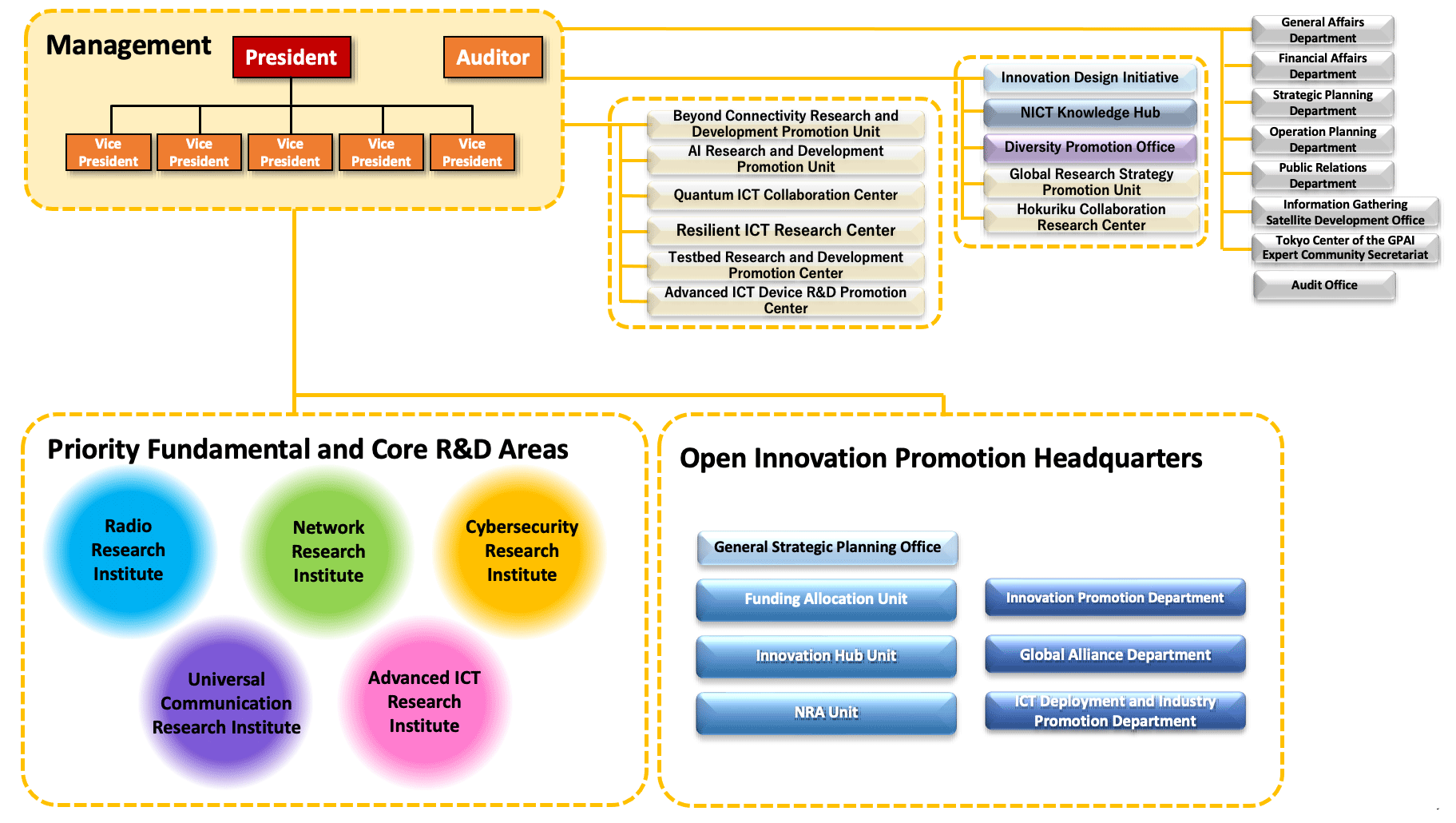
[Click picture to enlarge]
Media Contact
Press Office, Public Relations Department
E-mail: publicity nict.go.jp
nict.go.jp