




A Multiplexed Quantum Photonic Interface for Neutral-Atom Quantum Computers
— New Technology for Large-Scale Networked Quantum Computers —
September 1, 2026
Osaka, Japan - A research group in Japan led by Professor YAMAMOTO Takashi, Deputy Director, Center for Quantum Information and Quantum Biology / Graduate School of Engineering Science, the University of Osaka, in collaboration with the National Institute of Information and Communications Technology (NICT) and Hamamatsu Photonics K.K., has successfully demonstrated a world-record 10-channel multiplexed quantum photonic interface based on an integrated waveguide array, a key technology for optically interconnecting multiple quantum computers.
Neutral-atom quantum computers are expected to use arrays of approximately 10,000 atoms, with each atom serving as a qubit. However, fault-tolerant universal quantum computers are expected to require more than one million qubits for error correction. One promising route to this scale is therefore to interconnect multiple quantum processors by distributing entangled photons between them. This requires a multiplexed quantum photonic interface capable of linking many qubits in parallel.
Previous multiplexing approaches mainly relied on parallel optical fibers and were limited to only a few channels. Their insufficient integration density and wide atom spacing also made them difficult to apply to conventional neutral-atom quantum computers.
In this study, Professor YAMAMOTO’s research group developed an optical system incorporating an integrated optical waveguide array and demonstrated parallel photon delivery and detection from a neutral-atom array. Photons emitted from 10 atoms spaced at micrometer-scale intervals were coupled into 10 parallel channels of a 32-channel waveguide array, transmitted through optical fibers, and detected in parallel.
The experiment also confirmed negligible inter-channel crosstalk and correlations between the quantum states of the atoms and the polarization states of the emitted photons, supporting the interface’s potential for multiplexed atom-photon entanglement and quantum-processor networking. The approach is expected to be scalable to approximately 100 parallel channels.
Photon detection was performed using a multi-channel superconducting nanostrip photon detector system based on technology developed by Director of Superconductive ICT Device Laboratory, MIKI Shigehito, Kobe Frontier Research Center, Advanced ICT Research Institute, NICT and newly developed as a research system for this experiment by Manager SHIMOI Hideki at Electron Tube Division, Hamamatsu Photonics K.K.
“Through research and development spanning from neutral-atom arrays to superconducting nanostrip photon detector systems, we have achieved the first demonstration of a multiplexed optical interface,” said Professor YAMAMOTO. “Going forward, we will scale up the degree of multiplexing and work toward connecting neutral-atom quantum computers, accelerating progress toward a fault-tolerant networked quantum computer.”
This research represents an important step toward networked quantum computers with the scalability needed for fault-tolerant universal quantum computing. By enabling multiple quantum processors to be interconnected through parallel photonic links, the technology could support large-scale quantum computing architectures similar to modern data centers, where many computing modules work together as a single system.
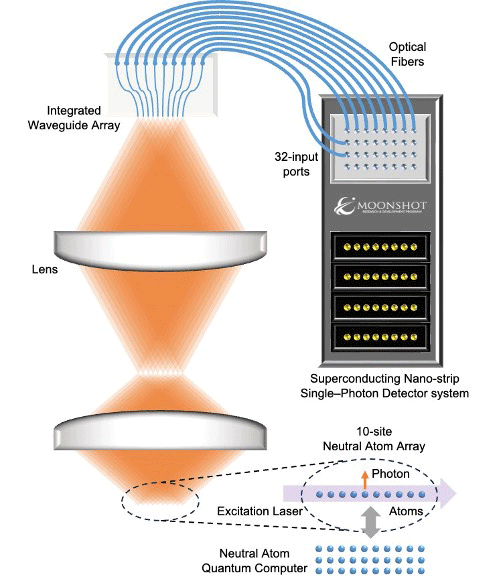
Figure 1. Experimental setup of the developed multiplexed quantum photonic interface
Roles of Each Institution in This Research
- The University of Osaka: Overall coordination and implementation of the research.
- NICT: Provided superconducting nanostrip photon detector technology and carried out part of the device fabrication process.
- Hamamatsu Photonics K.K.: Developed the superconducting nanostrip photon detector system for this research.
This research was conducted as part of the Japan Science and Technology Agency (JST) Moonshot Research and Development Program under Moonshot Goal 6: “Realization of a fault-tolerant universal quantum computer that will revolutionize economy, industry, and security by 2050,” specifically within the research projects “Fault-Tolerant Networked Quantum Computer” (JPMJMS256K) and “Quantum Cyberspace with Networked Quantum Computer” (JPMJMS2066).
This work was also supported by the JST Program on Open Innovation Platform for Industry-academia Co-creation (COI-NEXT), “Quantum Software Research Hub” (JPMJPF2014), the JST Adopting Sustainable Partnerships for Innovative Research Ecosystem (ASPIRE) (JPMJAP2319), and the Ministry of Internal Affairs and Communications (MIC) R&D Projects for Priority ICT Technologies (JPMI00316).
Part of the fabrication process for the superconducting nanostrip photon detector devices developed in this research was conducted using the facilities of the Advanced ICT Device R&D Promotion Center at NICT.
References
Authors: Yuya Maeda, Toshiki Kobayashi, Takuma Ueno, Kentaro Shibata, Shinichi Takenaka, Kazuki Ito, Yuma Fujiwara, Shigehito Miki, Hirotaka Terai, Tsuyoshi Kodama, Hideki Shimoi, Rikizo Ikuta, Makoto Yamashita, Shuta Nakajima, Takashi Yamamoto
Title: Waveguide-array-based multiplexed photonic interface for atom array
Journal: Optica
Article publication date: 31-AUG-2026
Related links:
Takashi Yamamoto
Technical Contact
YAMAMOTO Takashi
Professor at the Graduate School of Engineering Science
Deputy Director at the Center for Quantum Information and Quantum Biology
The University of Osaka
Tel: +81-6-6850-6445
E-mail: yamamoto.takashi.es osaka-u.ac.jp
osaka-u.ac.jpMIKI Shigehito
Director of Superconductive ICT Device Laboratory
Superconductive ICT Device Laboratory
Kobe Frontier Research Center
Advanced ICT Research Institute
National Institute of Information and Communications Technology
E-mail: s-mikinict.go.jp
nict.go.jpMedia Contact
Planning Office
Center for Quantum Information and Quantum Biology
The University of Osaka
E-mail: press_qiqbml.office.osaka-u.ac.jp
ml.office.osaka-u.ac.jpPress Office
Public Relations Department
National Institute of Information and Communications Technology
E-mail: publicitynict.go.jp
nict.go.jp About JST Moonshot Research and Development Program
FUJII Kenji
Department of Moonshot Research and Development Program
Japan Science and Technology Agency
E-mail: moonshot-infojst.go.jp
jst.go.jp