




World Record: 450 Tb/s Transmission Over a Metropolitan Link Using Legacy Optical Fiber
Highlights
-
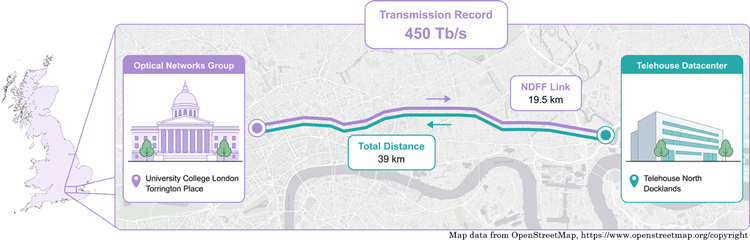
A new world record for optical data transmission: 450 Tb/s over a metropolitan network.
-
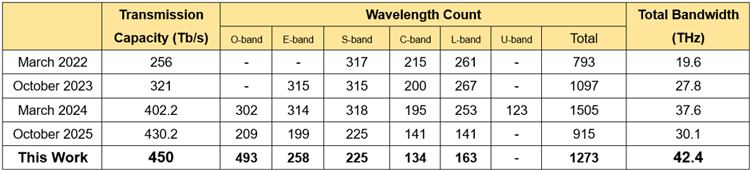
The transmitted signal occupied 42.4 THz of bandwidth - the widest ever sent through an optical fiber.
-
The result was achieved over already-installed (legacy) optical fiber in London, UK, linking University College London to the Telehouse North data center.
Background
Achievements
Future Prospects
Reference
Previous NICT Press Releases
- Novel Transmission Technique Enables World Record 430 Tb/s in a Commercially Available, International-Standard-Compliant Optical Fiber
https://www.nict.go.jp/en/press/2025/11/11-1.html - World Record 402 Tb/s Transmission in a Standard Commercially Available Optical Fiber
https://www.nict.go.jp/en/press/2024/06/26-1.html - World Record 301 Tb/s Transmission in a Standard Commercially Available Optical Fiber
https://www.nict.go.jp/en/press/2024/01/29-1.html - World's First Successful Transmission of 1 Petabit per Second in a Standard Cladding Diameter Multi-core Fiber
https://www.nict.go.jp/en/press/2022/05/30-1.html
Related Press Release
- New fibre optic data transmission speed record (UCL News)
https://www.ucl.ac.uk/news/2026/apr/new-fibre-optic-data-transmission-speed-record
Appendix
1. Newly developed transmission system
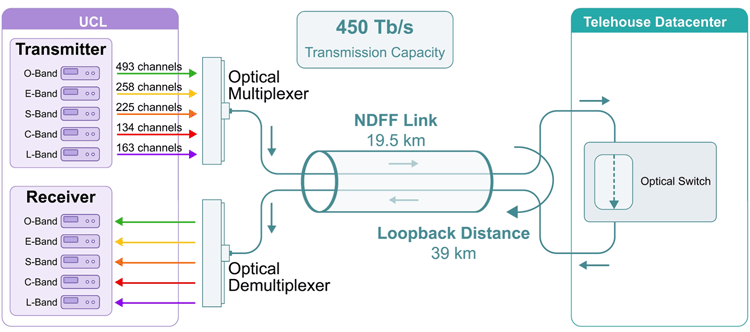
The system uses bismuth-, thulium- and erbium-doped fiber amplifiers. The signal is generated at the UCL campus and sent over the NDFF fiber to the Telehouse data center, where it is looped back over a second fiber to UCL for reception and processing. The total achieved capacity was 450 Tb/s.
2. Results of experiment
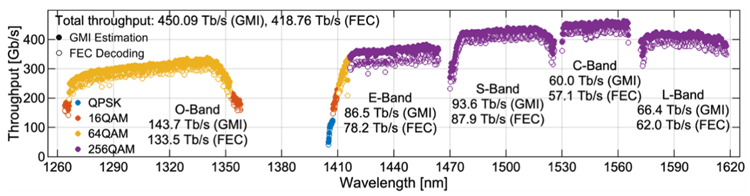
The colors indicate the selected modulation formats for each channel.
Glossary
International Research Partners This work is the result of an extensive international collaboration between NICT (Japan), University College London (UK), Aston University (UK), Lightera Laboratories (USA), Nokia Bell Labs (USA) and the University of Bristol (UK). Back to contents
Transmission bands (OESCL) / Wavelength bands (Optical fiber transmission windows)

Various wavelength bands for optical fiber transmission, as summarized in Figure 4, are defined by regions with distinct transmission characteristics, set by the physical properties of the fiber and the available amplifier technology. The C-band (1,530 - 1,565 nm) and L-band (1,565 - 1,625 nm) are the most commonly used for long-haul commercial systems, while the O-band (1,260 - 1,360 nm) is typically used for short-range or inter-data-center links. More recently, S-band (1,460 - 1,530 nm) experiments have become possible thanks to thulium-doped fiber amplifiers (TDFAs), and bismuth-doped fiber amplifiers (BDFAs) have been developed for the O-band and E-band (1,360 - 1,460 nm). In this experiment we used BDFAs and TDFAs for the O-, E- and S-bands, and erbium-doped fiber amplifiers (EDFAs) for the C- and L-bands. Back to contents
Quadrature-amplitude modulation (QAM) QAM is a technique for encoding information onto an optical signal by varying both the phase and the amplitude of the light wave, allowing many bits of data to be packed into a single symbol. 4-QAM uses 4 different signal symbols to carry 2 bits of information per symbol, while 256-QAM uses 256 different symbols and can therefore carry 8 bits of information per symbol (28 = 256 symbols). The spectral efficiency of 256-QAM is therefore eight times higher than that of simple formats such as on-off keying. Similarly, 64-QAM carries 6 bits per symbol over 64 different signal levels, and 16-QAM carries 4 bits per symbol over 16 levels. QAM symbols can also be transmitted on both polarizations of the light at once, doubling the number of bits per symbol to 16, 12 or 8 for DP-256QAM, DP-64QAM and DP-16QAM respectively. Back to contents
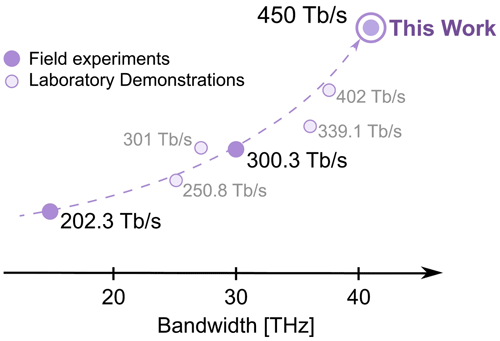
Past achievements in wideband transmission experiments Figure 5 shows previous wideband, high data-rate (>200 Tb/s) transmission experiments performed in single-mode fibers; previous NICT contributions are highlighted. The previous record, set at the 2024 Optical Fiber Communication Conference (OFC), reached a data rate of 402 Tb/s over a 37.5 THz bandwidth. Back to contents
Technical Contact
LUIS Ruben, FURUKAWA Hideaki
Photonic Network Laboratory
Photonic ICT Research Center
Network Research Institute
 ml.nict.go.jp
Media Contact
Press Office
Public Relations Department
nict.go.jp