






Focused Areas of Research and Development
The National Institute of Information and Communications Technology (NICT) has started the Fifth Mid-to-Long-Term Plan for five years from April 1, 2021 to March 31, 2026.
During the term of the Fifth Mid-to-Long Term Plan, NICT promote research and development in the fields of Advanced Electromagnetic Research, Innovative Networks, Cybersecurity, Universal Communication, and Frontier Science as priority research and development fields. We also actively promote R&D in four strategic research areas (Beyond 5G, AI, Quantum Information and Communication, and Cyber Security). As cross-field R&D and other business including the four strategic research areas, NICT promote R&D of ICT regardless of the field, including R&D of comprehensive test beds. The following figure shows the overall diagram of NICT's Focused Areas of Research.
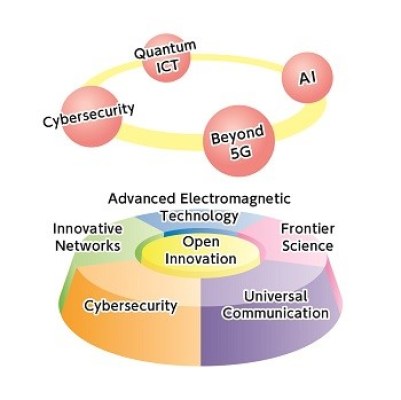
and open innovation
1.Advanced Electromagnetic Research
We conduct R&D on technologies to acquire, collect, visualize and provide diverse information from various things and phenomena surrounding human beings by using electromagnetic waves; technologies to ensure electromagnetic compatibility (EMC) of various equipment and systems (including terahertz waves); space-time standards technologies to generate, supply, and utilize accurate and reliable time and frequencies as a basis for efficient socioeconomic activities; remote sensing technologies, space environment measurement technologies, electromagnetic environmental technologies, space-time standards technologies, digital optical technologies to realize low-cost and high-efficiency diffractive optical devices.
Learn more: Advanced Electromagnetic Research
Related Departments
Keywords
electromagnetic engineering, radio wave propagation, electromagnetic field measurement, electromagnetic field analysis, remote sensing, radar technology, LIDAR/optical measurement technology, satellite mounted sensor, space weather, ionosphere, magnetosphere, the Sun and solar wind, electromagnetic compatibility (EMC), calibration technology, electromagnetic interference, biological electromagnetic environment, frequency standard, optical clock, chronological algorithms, Space-Time synchronization, satellite positioning, holographic optical technology, terahertz waves, Beyond 5G
2. Innovative Networks
We conduct R&D on key technologies to build innovative networks that can cope with the rapid increase in communication traffic, ensure communication quality, and diversify services toward the transformation of social systems through the advancement of Society 5.0 in the Beyond 5G era. We research and develop basic and system technologies for optical communications (backbone and access), wireless communications (terrestrial and satellite), ICT devices, networking, etc., to achieve the desired functions of broadband communications, ultra-low latency and high reliability in Beyond 5G, as well as fusion technologies such as optical and radio wave, computational function network composite, NTN, resilient ICT, etc., to enhance scalability and flexibility. We will support society in the Beyond 5G era by researching and developing technologies and promoting the diffusion of results.
Learn more: Innovative Networks
Related Departments
Keywords
networks, Beyond 5G, Photonic ICT, ultra high frequency and terahertz ICT, space ICT, resilient ICT, fiber optic communications, ICT devices, optoelectronic fusion (electrical and radio), wireless communications, space optical communications, cubesat, NTN, wireless access, architecture, network protocol, network control management, communication methods, machine learning
3. Cybersecurity
The Cybersecurity Research Institute works to protect Japan from increasingly sophisticated cyber threats by advancing practical cybersecurity research, fundamental cryptography, and innovative studies that combine AI and cybersecurity. Our goal is to become a globally recognized center of excellence for cybersecurity research and development.
In line with national policies, we also carry out cybersecurity exercises, promote collaboration among industry, academia, and government, and take action to address vulnerable IoT devices across Japan.
Learn more: Cybersecurity
Related Departments
Keywords
cybersecurity, usable security, Beyond 5G/6G security, AI security, brain security, modern cryptography, post-quantum cryptography, cryptographic security evaluation, privacy protection, cybersecurity workforce development, cybersecurity exercises, industry–academia–government collaboration, IoT security
4. Universal Communication
- Aiming at universal communication in which each and everyone can understand one another, we will develop communication technologies and multilingual data infrastructures that promote mutual understanding beyond not only language barriers, but also cultural barriers or real-virtual barriers. These technologies will leverage AI to understand multimodal data and context such as speech or images and enable the transmission not only of linguistic information but also of non-verbal information such as actions and gestures.
- Utilizing Large Language Models (LLMs) and related technologies developed using massive training datasets we constructed ourselves, we will address the various risks associated with LLMs. This includes the development of technologies that automatically analyze and evaluate the outputs of diverse LLMs, and of active evaluation platforms capable of automatically synthesizing training data to correct identified issues. In addition, we will pursue research on advanced forms of AI such as AI with enhanced creativity or AI capable of self-awareness and self-transformation.
- By linking and integrating various types of public and private data across different domains, we will create platforms and technologies for smart data utilization that will enable action support by analyzing and predicting real-world situations.
- We will also develop technologies that realize communication beyond the constraints of space, time, and the human body.
Learn more: Universal Communication
Related Departments
Keywords
multilingual communication, dialogue, action support, artificial intelligence (AI), generative AI, foundation models, large language models (LLMs), multimodal, real–virtual fusion, human interface, computer vision, Beyond 5G
5. Frontier Science
We conduct R&D on technologies that bring a new paradigm shift to the future ICT: next-generation functional device technology with high functionality and high efficiency by applying new functional materials such as compound semiconductors, superconductors, organic materials, biomaterials, and advanced nanofabrication technology; artificial intelligence (AI) and machine learning technologies to create materials and sensors, etc. with new functions; ultra-high frequency (terahertz) technologies for the utilization of unused frequencies; quantum info-communication technologies for the pursuit of ultimate safety, high-capacity characteristics, and ultra-high speed operations based on principles of quantum mechanics; Bio-ICT and Neuro-ICT technologies aimed at elucidating the useful functions of biological materials, as well as the mechanisms of substance metabolism and information flow involved in life activities, and leveraging these as ICT; and so forth. Besides, we conduct the R&D in emerging and interdisciplinary areas related to these technologies.
We conduct R&D on new information analysis and info-communication technologies inspired by the brain's information processing mechanism learned through the analysis of human brain functions; brain function measurement and analysis technologies to realize such new technologies; technologies to store and utilize large volumes of brain function information.
Learn more: Frontier Science
Related Departments
Keywords
nano-scale functional assembly ICT, bio-ICT, neuro-ICT, DUV ICT device, quantum ICT, terahertz ICT, green ICT (Gallium oxide device), future-oriented information analysis and information and communications technology, novel concepts for ICT, material sciences for ICT, information and neural networks, brain measurement, brain machine interface (BMI), Beyond 5G/6G
6. Cross-field R&D and other business
Looking ahead to the Beyond 5G era, this is a field that collaborates cross-sectionally with the R&D of the above five fields and contributes to the creation of open innovation through both R&D and social implementation. Specifically, we are looking for people who can play an active role in the strengthening of Japan's international competitiveness in Beyond 5G, the establishment of cutting-edge elemental technologies, their social implementation and overseas expansion, promoting the creation of new value and social implementation through the utilization of AI technologies, the development of strategic ICT human resources in quantum technology, etc., R&D on network technologies for integration of next-generation communications and computing, CPS applications, digital twin, and network emulation, promotion of R&D through collaboration among industry, academia, and government aimed at realizing Beyond 5G and solving social issues, and DX promotion and information security within the Institute, including the development, operation, and management of information systems, and so forth.
Reference sites
Quantum ICT Collaboration Center
ICT Testbed Research and Development Promotion Center
Open Innovation Promotion Headquarters
Keywords
Beyond 5G/6G, ultra-high frequency/terahertz wave, AI, quantum ICT, Human resource development, quantum cryptography, quantum internet, testbed, technology demonstration, emulation, distributed wide-area demonstration, data-driven, fusion of cyberspace and physical space, integrated network technology for communication and computing, interdisciplinary data collaboration in telecommunications, open innovation, industry-academia-government collaboration, international collaboration, global expansion , DX, information system, information security
*For this research area, you may also select from the keywords listed in other areas (1-5) above.