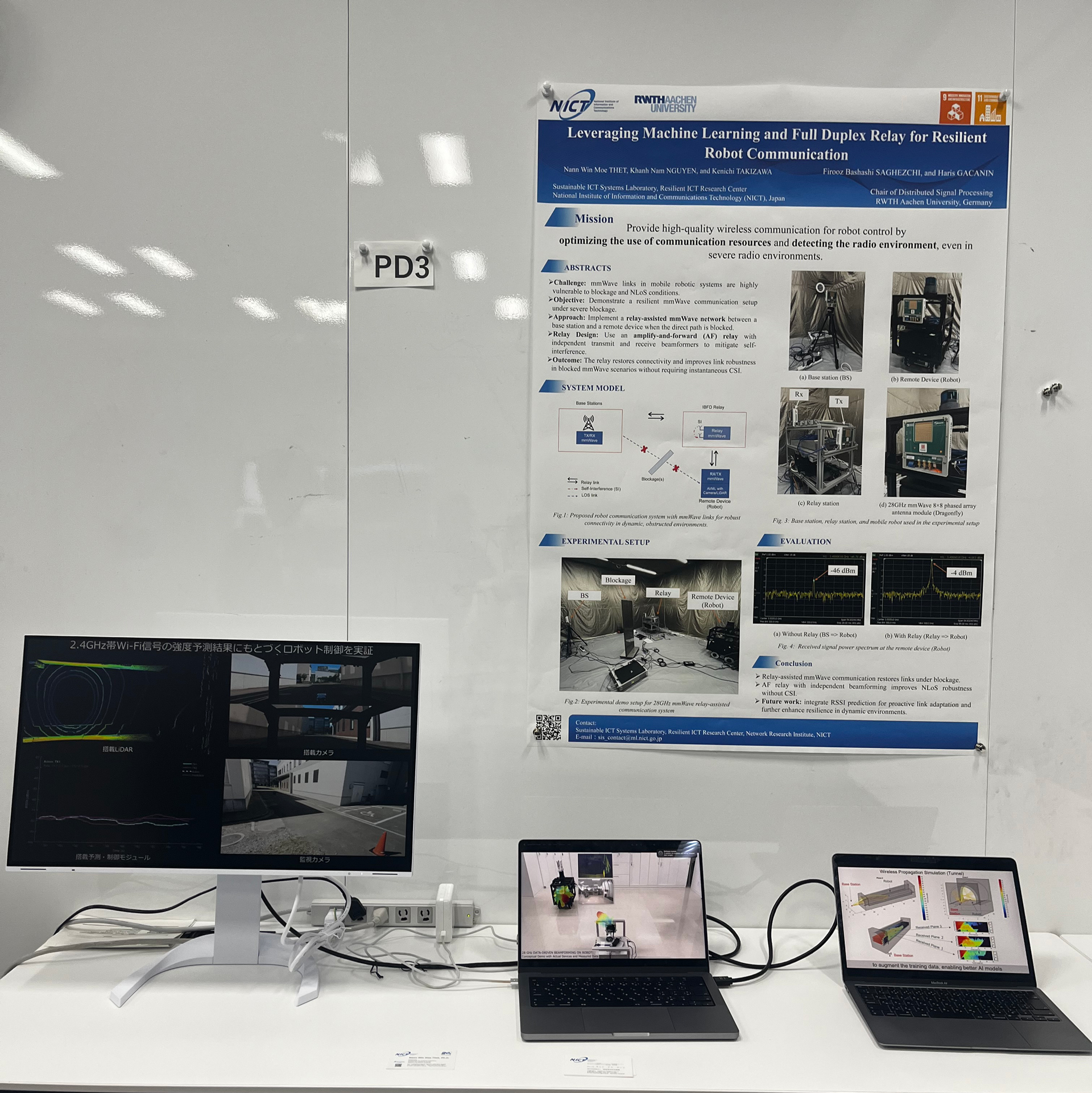




Presentation on “Next‑Generation Resilient Wireless Technology: mmWave Relay Communication with Machine‑Learning RSSI Prediction” at the 7th Germany–Japan Beyond 5G/6G Research Workshop.
[日本語]
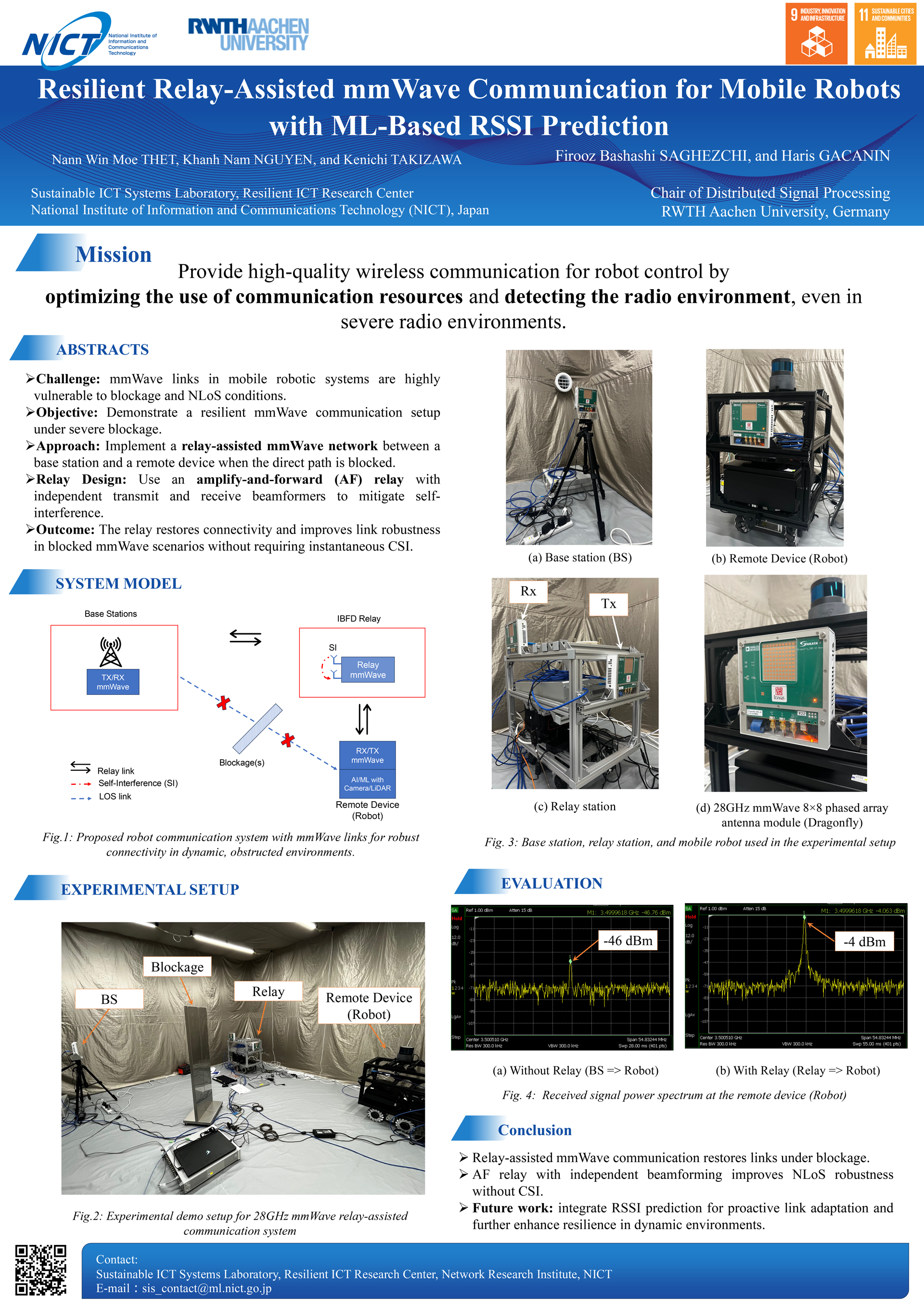
During the Demonstration Session of the 7th Germany–Japan Beyond 5G/6G Research Workshop, held on January 21–22 at Tokyo Nihonbashi Tower, the Resilient ICT Research Center Sustainable ICT Systems Laboratory, in collaboration with the Chair for Distributed Signal Processing, RWTH Aachen University, presented a poster and a video demonstration on “Resilient Relay-Assisted Millimeter-wave (mmWave) Communication for Mobile Robots with Machine Learning (ML)-based RSSI Prediction.”
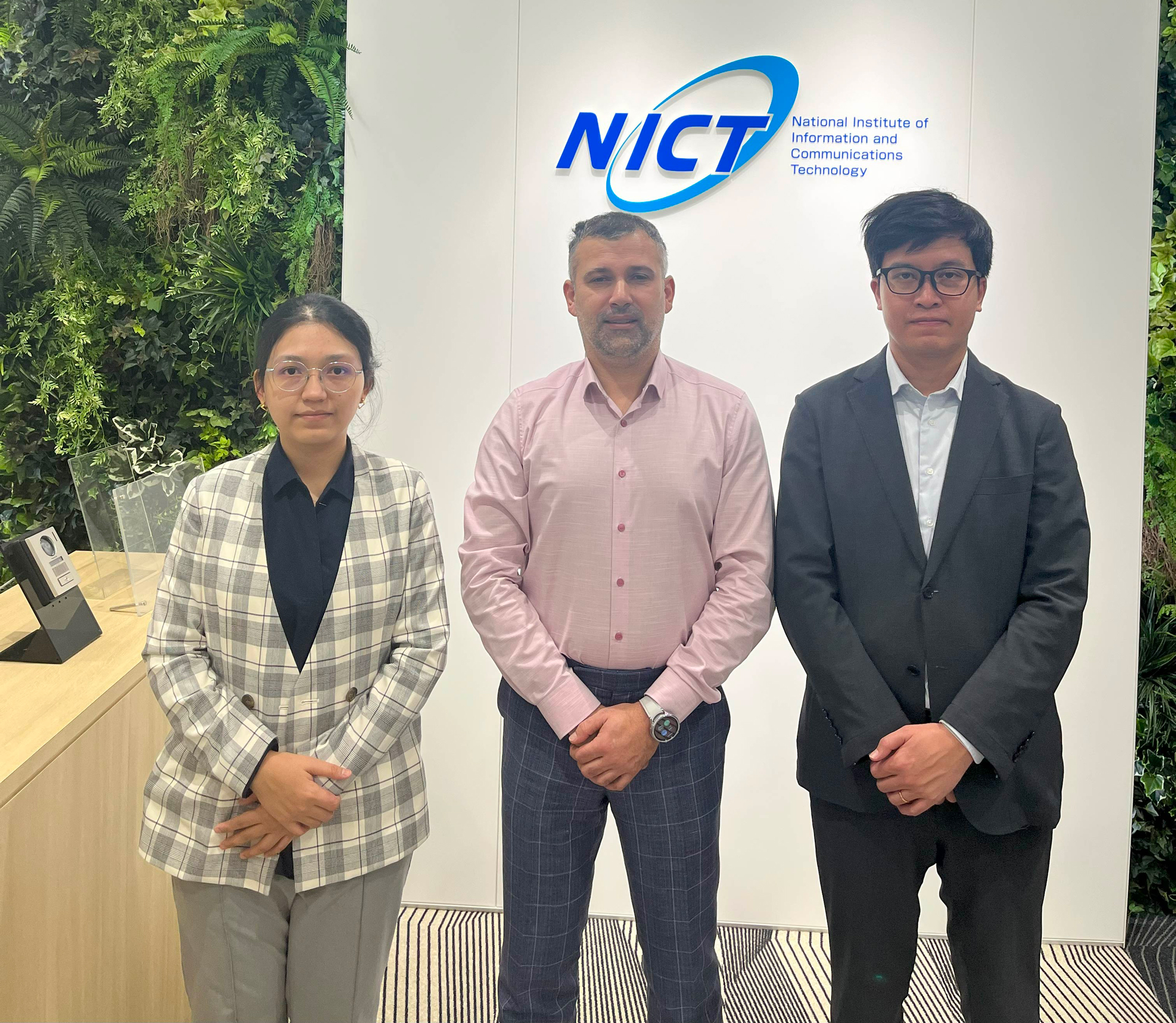
Maintaining high-quality wireless communication in severe radio environments is a critical challenge, where blockage, interference, and rapidly changing conditions can cause sudden link degradation. Mobile and autonomous robots were used as practical examples of systems operating in harsh or disaster-like environments, where humans cannot safely access and reliable connectivity is essential for navigation, monitoring, and task execution.
MmWave communication is particularly valuable in scenarios that require ultra-high data rates and low latency, but it is highly susceptible to blockage and non-line-of-sight (NLoS) conditions. To enhance resilience, the team developed a relay-assisted communication framework integrated with ML-based RSSI prediction, enabling proactive adaptation in harsh and dynamically changing radio environments.
The poster featured the experimental 28 GHz mmWave relay-assisted communication system, with an amplify-and-forward relay using independent transmit and receive beamformers to maintain connectivity under blockage and NLoS conditions. The demonstration also showcased mmWave beamformer and ML-based RSSI prediction applied in Wi-Fi (2.4 GHz) and local 5G systems (4.9 GHz) across different use cases, including a mock industrial environment and a search-and-rescue scenario, illustrating how the system can anticipate link degradation and demonstrating the potential for future dynamic adaptation between direct and relay-assisted paths.
The presentations attracted strong interest from participants representing Japanese universities, mobile communication vendors, and German research institutes.
MmWave communication is particularly valuable in scenarios that require ultra-high data rates and low latency, but it is highly susceptible to blockage and non-line-of-sight (NLoS) conditions. To enhance resilience, the team developed a relay-assisted communication framework integrated with ML-based RSSI prediction, enabling proactive adaptation in harsh and dynamically changing radio environments.
The poster featured the experimental 28 GHz mmWave relay-assisted communication system, with an amplify-and-forward relay using independent transmit and receive beamformers to maintain connectivity under blockage and NLoS conditions. The demonstration also showcased mmWave beamformer and ML-based RSSI prediction applied in Wi-Fi (2.4 GHz) and local 5G systems (4.9 GHz) across different use cases, including a mock industrial environment and a search-and-rescue scenario, illustrating how the system can anticipate link degradation and demonstrating the potential for future dynamic adaptation between direct and relay-assisted paths.
The presentations attracted strong interest from participants representing Japanese universities, mobile communication vendors, and German research institutes.